Even, Bright, Healthy-Looking Skin, Treated at the Source
Sun exposure, hormonal changes, and years of everyday skin stress can leave dull patches, dark spots, and uneven tone that no amount of home skincare fully resolves. Skin whitening treatment in Islamabad, when it’s done with the right technology and the right hands, targets this at the source instead of just masking it.
At ARB Clinic, laser skin whitening and skin brightening treatments are overseen personally by Dr. Afsheen Bilal, a dermatologist with 21 years of clinical experience, who assesses your skin type and pigmentation pattern before recommending a laser type and session plan.
The goal here isn’t to change who you are, it’s to treat genuine sun damage, pigmentation, and dullness so your skin looks like its healthiest, most even version of itself.
Skin Whitening at At ARB Clinic
| Treatment | Laser skin whitening / skin brightening for uneven tone, sun damage, and pigmentation |
| Clinic | ARB Clinic Islamabad |
| Specialist | Dr. Afsheen Bilal, MBBS Gold Medalist, FCPS Dermatology, 21 years of experience |
| Location | House A-58, Main Margalla Road, F-7/2, Islamabad |
| Session time | 20-45 minutes, depending on area treated |
| Best for | Uneven skin tone, sun-induced pigmentation, dullness, dark spots |
| Downtime | None to minimal |
| Results timeline | Gradual improvement over 2-4 sessions, spaced 3–4 weeks apart |
| Starting price | Confirmed after consultation, based on treatment area and number of sessions |
What Determines Skin Tone?
Skin tone is largely determined by melanin, a pigment produced by cells called melanocytes. How much and what type of melanin your skin produces depends on a mix of factors:
- Genetics: Genes such as SLC24A5 directly influence how much melanin your skin produces, which is why skin tone varies naturally across individuals and populations.
- Sun Exposure: Sun exposure is one of the biggest drivers of extra melanin production, which is why sun-exposed areas often develop uneven tone, dark spots, and patches over time.
- Hormonal and Health Factors: Pregnancy, certain medications, and skin conditions can all trigger melanocytes to become more active, leading to patches of darker skin.
Understanding what’s actually driving your pigmentation is the first step before choosing any skin brightening or skin lightening treatment, since the right approach depends on the cause.
Can uneven skin tone be fixed permanently?
Yes, in most cases. Pigmentation caused by sun exposure, hormones, or minor skin trauma typically responds well to the right combination of treatment and sun protection. The exception is deep, long-standing melasma, which can be significantly improved but tends to need ongoing management rather than a single fix.
What Is Laser Skin Whitening and How Does It Work?
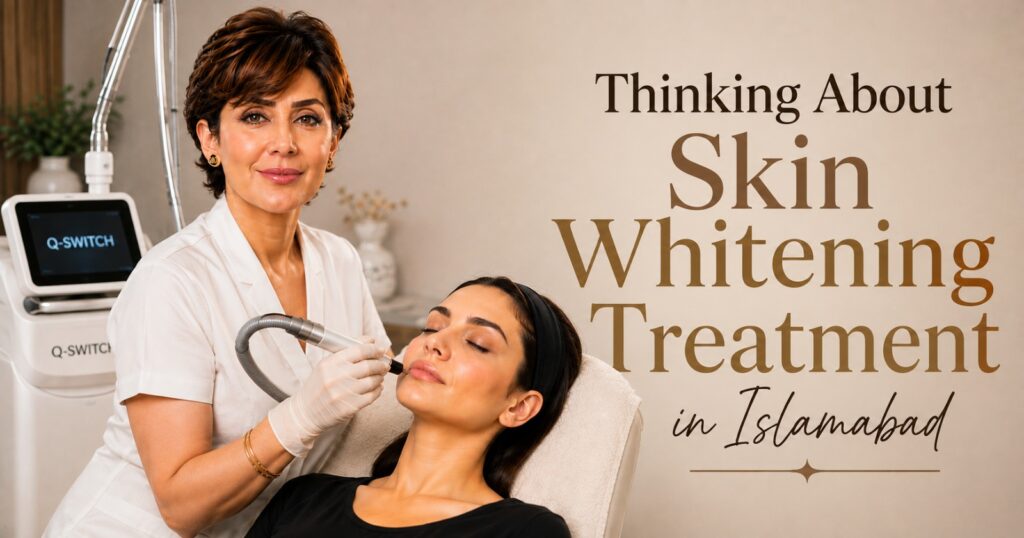
Laser skin whitening, sometimes called skin brightening or skin lightening, uses specific wavelengths of light to target excess melanin beneath the skin’s surface. The laser energy is absorbed by pigment cells and breaks them down, allowing the body to naturally clear the fragmented pigment over the following days and weeks.
At ARB Clinic, this is typically performed using Q-switched Nd:YAG laser technology, which is well suited to targeting melanin precisely while minimizing impact to the surrounding skin. Depending on your skin’s needs, this may be combined with other modalities Dr. Afsheen Bilal has available, such as IPL for broader sun damage or fractional resurfacing for texture.
Does laser skin whitening damage your skin?
No, not when performed correctly. The laser is designed to target melanin selectively, leaving the surrounding skin structure largely undisturbed. This is why choosing an experienced, dermatologist-led clinic matters, incorrect laser settings are what cause surface damage, not the technology itself.
Laser Skin Whitening vs. Other Brightening Options
Laser treatment isn’t the only way to address uneven tone, but it tends to work faster and more precisely on stubborn pigmentation than surface-level options alone.
| Approach | What It Does | Typical Timeline |
| Laser Skin Whitening/Brightening | Targets and breaks down excess melanin at the source using laser energy; addresses stubborn, deeper pigmentation | 2-4 sessions, visible results over 4–8 weeks |
| Topical Lightening Creams | Gradually inhibits melanin production at the surface; requires consistent daily use | 8-12+ weeks for visible change |
| Chemical Peels | Exfoliates the outer skin layers to reduce surface pigmentation and improve tone | 3-6 sessions, 2-4 weeks apart |
Many patients combine laser sessions with a home skincare routine for longer-lasting results; Dr. Afsheen Bilal will advise what’s appropriate for your skin at consultation.
Which works faster, laser or whitening cream?
Laser skin whitening generally works faster than topical creams because it targets pigment beneath the surface directly, rather than relying on gradual inhibition of melanin production. Most patients see visible change within 2 to 3 sessions, compared to 8 or more weeks of consistent use for creams to show similar results.
Why ARB Clinic for Skin Whitening in Islamabad
Overseen Personally by Dr. Afsheen Bilal
MBBS Gold Medalist, FCPS Dermatology, 21 years of clinical experience. Your treatment plan and laser settings are determined by her directly, based on your actual skin type, not a fixed protocol.
Treatment Matched to the Cause, Not Just the Symptom
Uneven tone can come from sun damage, hormones, or an underlying condition like melasma. Getting this right matters, since melasma in particular needs a different, more conservative approach than general sun-related pigmentation (see our dedicated melasma treatment page if that sounds like your case).
Calibrated for Pakistani and South Asian Skin Tones
Medium-to-deep skin tones carry a higher risk of rebound pigmentation if lasers are used too aggressively. Settings are calibrated conservatively to reduce this risk.
Realistic Expectations, Set Upfront
Skin whitening treatments improve tone and clarity, they don’t permanently change your natural skin color. You’ll know exactly what to expect before you commit to a session plan.
Book Your Consultation With Dr. Afsheen Bilal
Who Is a Good Candidate for Laser Skin Whitening?
You may be a strong candidate if you:
- Have visible sun damage, dark spots, or an uneven overall skin tone
- Have generally healthy skin, without active infection or severe skin conditions
- Have realistic expectations about what the treatment can and can’t change
- Are looking for a more targeted option after topical products haven’t worked well enough
Treatment may need to be delayed or reconsidered if you:
- Are pregnant or breastfeeding (some hormonal pigmentation is best addressed after this period)
- Have active acne, an active skin infection, or open wounds in the treatment area
- Have had recent, significant sun exposure or a sunburn
- Have a history of keloid scarring or very reactive, sensitive skin (discuss this at consultation)
Not Sure If You’re a Candidate?
Can I get skin whitening treatment if I have sensitive skin?
Often yes, but it requires extra caution. Sensitive or reactive skin types are assessed carefully at consultation, and laser settings are adjusted accordingly, sometimes starting with a lower intensity or a patch test before a full session.
What to Expect: Before, During, and After Your Treatment
Before Your Treatment
- A consultation to assess your skin type, pigmentation pattern, and the likely cause of your unevenness
- Guidance to avoid direct sun exposure and tanning for at least 1-2 weeks before your first session
- Avoiding retinoids or other active skincare ingredients for a few days prior, as advised
During Your Treatment
- The area is cleansed and protective eyewear is provided
- The laser is passed over the treatment area in controlled passes; most patients describe a warm, snapping sensation
- Sessions typically take 20 to 45 minutes, depending on the area treated
After Your Treatment
- Mild redness or warmth is common immediately after and usually settles within a few hours to a day
- Some patients notice mild flaking or darkening of spots before they clear, this is a normal part of the pigment breaking down
- Sun protection (SPF 50+, daily) is essential after treatment, this is non-negotiable for keeping results and avoiding rebound pigmentation
- Most patients return to normal activities the same day
Does laser skin whitening hurt?
Most patients describe it as mildly uncomfortable rather than painful, often compared to a warm, snapping sensation against the skin. Numbing cream can be applied beforehand for larger areas or more sensitive skin.
What Results Can You Expect?
Most patients need 2 to 4 sessions, spaced 3 to 4 weeks apart, to see meaningful improvement in tone and clarity. Some initial brightening is often visible after the first session, with fuller results building over the full course of treatment.
Results are not permanent in the sense of changing your natural skin tone forever, ongoing sun protection and, in some cases, periodic maintenance sessions are what keep skin looking even over the long term.
How soon will I actually see results?
Many patients notice some brightening after the very first session, though this varies by skin type and how deep the pigmentation sits. The fuller, more even result builds progressively as you complete your full course of sessions.
Ready for Clearer, More Even-Toned Skin?
Getting real, lasting results starts with correctly identifying what’s causing your unevenness in the first place, not just booking a generic package. Dr. Afsheen Bilal will assess your skin and build a laser plan matched specifically to you.
Is It Sun Damage or Something More? A 5-Minute Skin Tone Self-Check
Step 1: Where Is the Discoloration?
Check what matches you: scattered spots on sun-exposed areas (face, hands, arms), symmetrical patches on both cheeks or the forehead, dullness across your whole face rather than distinct spots, dark patches that showed up after an injury, breakout, or pregnancy.
Scattered spots on sun-exposed areas usually point to sun damage. Symmetrical patches are more characteristic of melasma. Dark marks after an injury or breakout are usually post-inflammatory pigmentation, a different and often easier condition to treat.
Step 2: What Makes It Worse?
Check any that apply: gets darker with sun exposure, gets darker with heat (cooking, exercise, hot weather), doesn’t seem to change much either way.
If heat is a clear trigger, melasma becomes more likely, and a gentler, more conservative treatment approach matters more here than with simple sun damage.
Step 3: What Have You Tried Already?
Check one: only sunscreen and basic skincare, whitening creams with some but limited improvement, nothing yet.
If topical products haven’t given you the improvement you want, laser treatment is often the next appropriate step, since it works at a different depth than surface creams.
Step 4: Any of the Following Apply to You?
Check if any apply: currently pregnant or breastfeeding, active acne or skin infection in the area, recent sunburn or heavy sun exposure.
If you checked any of these, treatment usually needs to be delayed. This will be confirmed clearly during your consultation.
What Your Answers Might Mean
- Scattered, sun-related spots, no contraindications: Laser skin whitening is likely a strong fit. This will be confirmed at your consultation.
- Symmetrical, heat-triggered patches: A more conservative, combination approach is usually recommended, worth mentioning this pattern specifically when you book.
- Any Step 4 concerns checked: Treatment will likely need to be delayed or modified. Be sure to mention this clearly when you book.
What to Do Next
This guide is a starting point, not a diagnosis. The only way to know your exact treatment plan is a real consultation.
Dr. Afsheen Bilal has 21 years of experience in dermatology and laser treatments. She’ll assess your skin and pigmentation pattern, and build a plan around your actual skin, not a fixed package.
Call or WhatsApp: +92 315 1620207. Visit: House A-58, Main Margalla Road, F-7/2, Islamabad.
Frequently Asked Questions (FAQs)
How much does skin whitening treatment cost in Islamabad?
Cost depends on the treatment area, the laser technology used, and how many sessions your skin needs. You’ll get an accurate quote after you consult with Dr. Afsheen Bilal, once your treatment plan is confirmed.
Is laser skin whitening safe?
Yes, when performed by a qualified dermatologist using settings appropriate for your skin type. Dr. Afsheen Bilal calibrates laser settings conservatively for South Asian skin tones to reduce the risk of rebound pigmentation.
How many sessions do I need for skin whitening?
Most patients need 2 to 4 sessions, spaced 3 to 4 weeks apart. Your exact number of sessions depends on the depth and cause of your pigmentation, confirmed at your consultation.
What's the difference between skin whitening, skin brightening, and skin lightening?
These terms are largely used interchangeably in the industry. At ARB Clinic, the goal is the same regardless of the term used: reducing excess melanin to even out tone and treat visible sun damage or dark spots, not altering your natural skin color.
How long does skin whitening treatment last?
Results can last long-term with consistent sun protection, though ongoing UV exposure can gradually bring pigmentation back. Some patients choose periodic maintenance sessions to sustain their results.
Does skin whitening treatment hurt?
Most patients describe a warm, snapping sensation during treatment rather than significant pain. Numbing cream can be applied for more sensitive areas or larger treatment zones.
Is skin whitening safe for dark skin tones?
Yes, when settings are calibrated correctly. This is exactly why choosing an experienced dermatologist matters, incorrect settings on darker skin tones can trigger rebound pigmentation, which Dr. Afsheen Bilal’s conservative, depth-matched approach is specifically designed to avoid.
Does skin whitening treatment work for melasma?
Laser skin whitening can help with general sun-induced pigmentation, but melasma specifically often needs a more conservative, combination approach. If your pigmentation is patchy, symmetrical, and worsens with heat or hormones, it may be melasma, worth mentioning at your consultation so the right protocol is used.
What should I avoid after laser skin whitening?
Avoid direct sun exposure, tanning, saunas, and harsh active skincare ingredients for at least a few days after treatment. Daily SPF 50+ is essential to protect your results long-term.
Is skin lightening treatment permanent or does it come back?
No treatment permanently changes your natural skin tone. Laser skin lightening clears existing pigmentation effectively, but ongoing sun exposure can gradually cause new pigmentation to form, which is why daily sun protection after treatment matters as much as the sessions themselves.
What is the best laser for skin whitening in Islamabad?
There isn’t one single “best” laser for every patient, the right choice depends on your skin type and the depth of your pigmentation. Q-switched Nd:YAG is the most commonly used laser for skin whitening and brightening, and Dr. Afsheen Bilal confirms the most suitable option after assessing your skin directly.
Can skin brightening treatment remove tan?
Yes, laser skin brightening is effective for treating tan and sun-related pigmentation, since it targets the excess melanin causing the discoloration directly. Most tan-related pigmentation responds well within 2 to 3 sessions.
Can I get skin whitening treatment if I have oily or acne-prone skin?
Yes, in most cases, though active acne or breakouts in the treatment area should clear first. Dr. Afsheen Bilal will assess your skin condition at consultation and confirm whether treatment can proceed immediately or should wait until any active breakout settles.
Can men get skin whitening treatment too?
Yes. Uneven tone, sun damage, and pigmentation affect men and women alike, and the treatment approach is the same regardless of gender, based on your skin type and pigmentation pattern, not on any other factor.
Can I go out in the sun after skin whitening treatment?
You can resume normal outdoor activity right away, but strict sun protection (SPF 50+, reapplied regularly) is essential from day one. Unprotected sun exposure shortly after treatment is one of the main causes of pigmentation returning faster than expected.
Is laser skin whitening better than glutathione injections or drips?
They work differently and aren’t directly interchangeable. Glutathione is taken internally and works gradually on overall tone from within, while laser skin whitening targets existing pigment directly in the treated area, with more visible, localized results in fewer weeks. Many patients ask about this specifically because glutathione is heavily marketed in Pakistan; Dr. Afsheen Bilal can explain which approach, or combination, suits your goals.
Do you have before and after photos of skin whitening treatment?
Yes, real patient results are available to view. Ask about relevant before and after examples during your consultation, or check the Before & After section on our website for examples of past results.